
Manlius Previous Residents Sources by Era
A backward address trail needs both title and household sources. Start with the current parcel record to establish the correct situs address, parcel number, owner spelling, tax mailing address, and legal description. Then use the source that best fits the time period. The table distinguishes a source that names title parties from one that merely supplies an address or household clue.
| Source | Years it covers | Where held | What it shows |
|---|---|---|---|
| County Clerk deeds and mortgages | County records begin 1794; online cutoff not located | Cott index; County Clerk office and Archives | Title parties, legal description, recording date, and mortgage details |
| Syracuse-area directories | 1844; listed 1850s runs; 1861-1935 | New York State Library | Names and addresses where coverage reaches Manlius |
| Local directory leads | 1884 business; 1886 town; Fayetteville 1926-27 | Holding institution to verify | Town or village name and address context |
| County and federal census | County Archives 1850-1925; federal release under 72-year rule | County Archives and federal channels | Household composition and enumeration geography |
| Maps, code files, and newspapers | Dates vary; 1894 Sanborn is a verification lead | Library, Town Code Enforcement, Archives, and repositories | Building, street, permit, notice, and local context clues |
Begin with title material when the question is who owned a parcel. Use directories and census schedules when the question is who lived there. An owner’s name, a tax mailing address, and an occupant should never be treated as interchangeable facts.
Freeze the Manlius Parcel Before a Backward Search
Town Assessment and Onondaga Image Mate are the first stop for a current parcel. The town directs property research to Image Mate, which can show inventory, assessed value, exemptions, and other property information. The public record is administrative and can change before the final roll around July 1, so record the retrieval date and compare the tentative and final rolls where the history requires it.
Write down five fields before opening an older record: situs address, parcel or tax-map number, legal description, owner spelling, and mailing address. Situs is the physical location. A mailing address is where tax correspondence goes and may point elsewhere. The legal description is the lot, block, tract, or metes-and-bounds language that lets a researcher recognize the same land despite changing street or postal labels.
Useful distinction. A current assessment entry is a starting control, not proof that every past owner or listed household actually occupied the address.
Tracing the Manlius Deed Chain Backward
Onondaga County Clerk records begin in 1794. Search the current owner as grantee in the deed index, then use the seller named in that instrument as the next grantee search. Keep the legal description constant through every turn. A deed can identify title parties and a legal description, but it does not show who occupied a building or what stood on the land.
- Copy the current assessor fields and identify the current owner as a grantee candidate.
- Locate the purchase deed in Cott or at the County Clerk, then record grantor, recording date, instrument or book-and-page reference, legal description, and image status.
- Search that grantor as a prior grantee, comparing the legal description rather than relying only on a street address.
- Repeat the sequence while noting lot, tract, subdivision, and map references that bridge an old description.
- When the online trail stops, take the known index placement to the County Clerk office or Archives rather than guessing an earlier transfer.
- Grantor
- The party transferring an interest in the deed being read.
- Grantee
- The party receiving that interest in the deed being read.
- Chain of title
- The dated sequence of conveyances used to follow title backward.
- Legal description
- The land description that can outlast a modern street name or postal label.
When the Manlius Deed Index Stops
Cott provides free guest index access through its “Sign In as a Guest” route. Images, viewing, and printing require an account and subscription, and some indexed records do not have images. The research did not establish the online cutoff for the post-1794 record set, so the historical start date cannot be turned into a claim of full online coverage.
The Onondaga County Cott eSearch entry is the source for the guest-access and image-gate screen shown here.
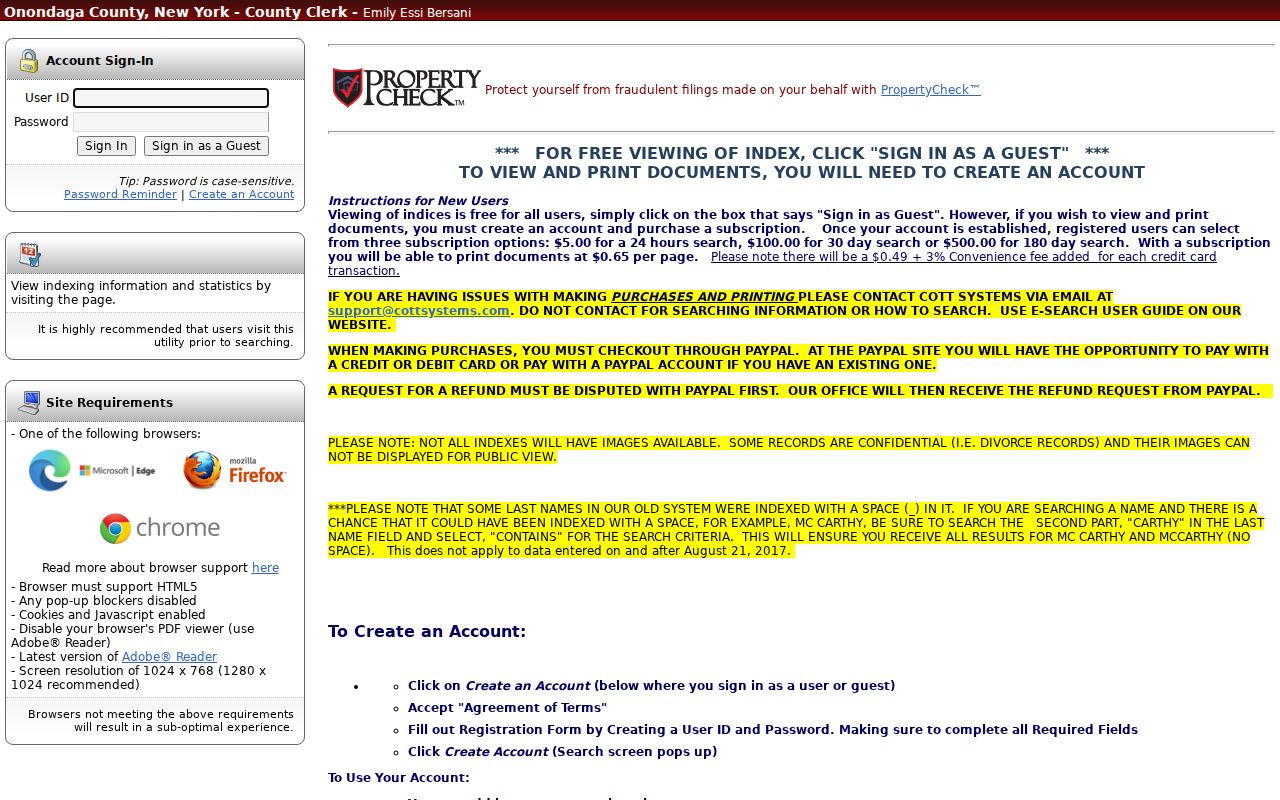
The county office and Archives are the fallback for 1794-present records, with Archives reachable at 315-435-2237 and Deeds/Mortgages at 315-435-8250. County Archives recommends directories, tract maps, business certificates, and deeds for historical property work. That pairing is more reliable than treating an online index as the whole record trail.
Manlius Previous Residents in Directories and Census Records
Title is only half the story. A directory can place a listed name or business at an address, while census material can show a household in an enumeration geography. For the Manlius collections themselves, the Manlius city directories page explains the dated Syracuse runs, the local leads, and the repository cautions. Here, use those sources to test whether a title party also appears as an occupant.
Start with the exact street spelling and house number in a reverse or criss-cross directory. Copy the occupant spelling, spouse notation, occupation, and nearby entries as printed. Check the next and prior available volume. Pair those dates with the released federal census and County Archives census holdings from 1850-1925, always reading the town, village, and enumeration-district heading. A directory entry can show an address association, but it does not prove title or current residence.
Manlius Previous Residents and the Local House-History Route
Manlius Library’s local-history page is the starting guide for a house-history inquiry. It links maps, the historic-district application, the Village of Manlius digital collection, NYS Historic Newspapers, and yearbook material, while directing fragile items to the Manlius Historical Society. County Archives adds directories, tract maps, business certificates, and deeds. The Cheney House Research Center is the specialist follow-up for local photographs, maps, papers, clippings, and research appointments.
The Manlius Library local-history page is the source for the maps and house-history paths illustrated below.
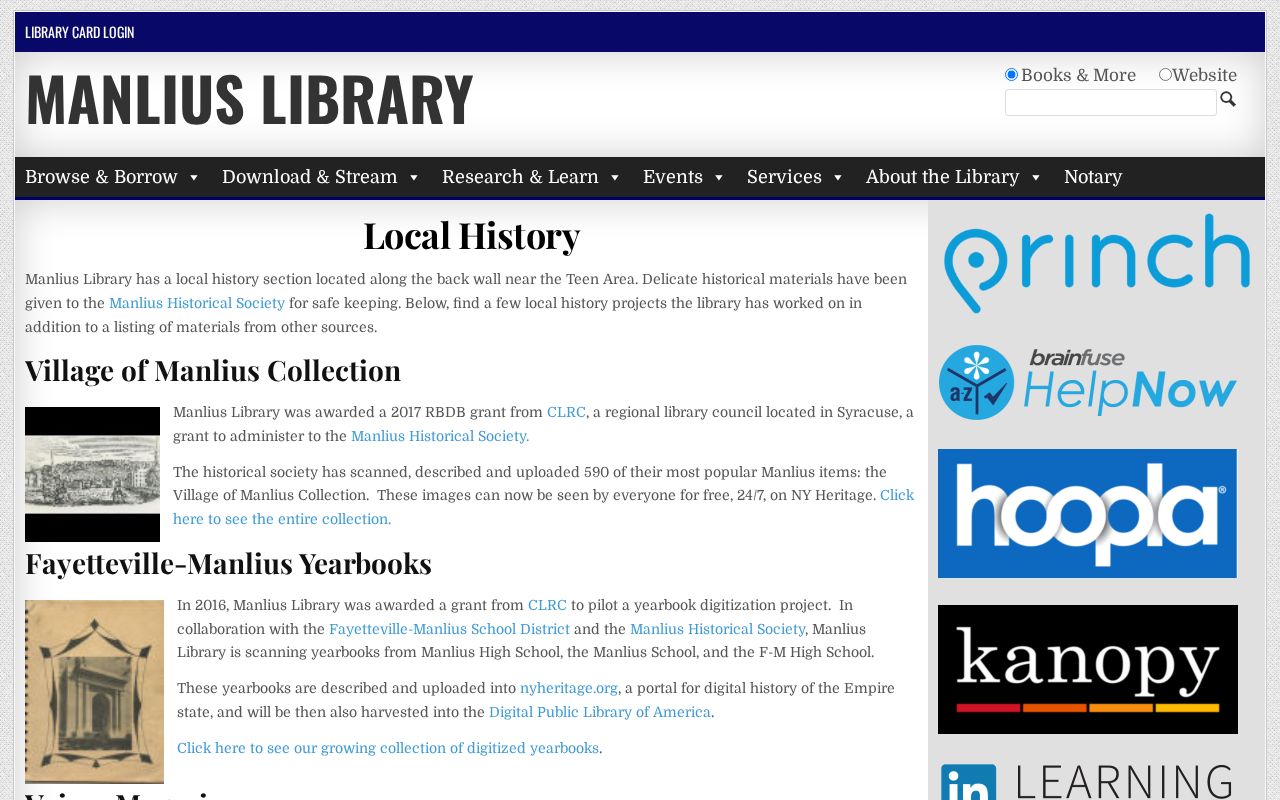
Map leads from 1854, 1860, 1874, and 1889 can help interpret road and building changes. The 1973 historic-district application covers roughly three blocks and 46 buildings around Seneca, Pleasant, and North streets. A June 1894 Manlius Sanborn item is only a genealogy-directory lead until a repository confirms the sheet or catalogue record.
Manlius Previous Residents and the Address-Continuity Trap
Do not assume an older place name rejects a record. The first Town of Manlius meeting was held in 1794 at Benjamin Morehouse’s Tavern, and the original town jurisdiction included areas now associated with Manlius, DeWitt, Syracuse east of Salina, and part of Salina. A nineteenth-century record can therefore use a parent town or village label that is not a modern mailing address.
Use the legal description, tract name, lot and block language, map context, and enumeration district to resolve the geography. The research did not locate a specific Manlius street-renumbering or street-renaming year. Record that uncertainty rather than silently matching an old address number to a current building. Postal identity is a separate check: Fayetteville, Minoa, Kirkville, and Manlius labels can appear on nearby but different municipal layers.
Manlius Previous Residents: Obituaries, Probate, and Permits
Newspaper and estate material can help close a household trail. Manlius Eagle holdings include 1887 and 1902-1933, while Herald of Times Manlius is an 1808-1809 State Library lead. An obituary can connect a name, family, and place, but it is not a replacement for a certificate. For estate questions, Surrogate’s Court at 401 Montgomery Street in Syracuse handles probate and estates; the file with the court remains the controlling source.
Town Code Enforcement is the address-keyed fallback for construction, alteration, demolition, sign, pool, inspection, and complaint history. No public searchable permit-case database was located. Request records by address, type, date range, and desired fields through the office or the Town FOIL channel. Permit material can date changes to a structure, but it does not create a complete household list.
Lawful personal use. Manlius previous-resident research is for family history, house history, estate questions, and personal curiosity. Do not use a historical clue to stalk, harass, or harm a living person.